Unlock Your Medspa’s Full Potential with Your Vision, Our Expertise, and Proven Systems
Unlock Your Medspa’s Full Potential with Your Vision, Our Expertise, and Proven Systems


A med spa can look busy and still bleed money, because a packed calendar hides as many problems as it solves. The trouble rarely comes from one big failure; it comes from a dozen small operational gaps that compound week after week.
Inventory that walks out untracked, payroll that outpaces bookings, providers who sit idle between appointments, and paperwork that goes missing all chip away at the same bottom line. Most owners feel only the symptom, which is a profit number that never matches how hard everyone is working.
At MedSpa Optimization, we’ve spent more than 20 years helping owners find and close those gaps before they turn into real losses. If your practice feels busier than it is profitable, you can request a free operations review and we’ll map where the money is leaking.
The most common med spa operational mistakes cluster in four areas: untracked inventory, staffing ahead of demand, idle-provider scheduling, and lapsed compliance and documentation. Each one is a slow, quiet drag on profit that owners learn to live with until someone finally measures it.
A full appointment book feels like success, and most owners treat it as the main scoreboard. The problem is that volume and profit are not the same number, and the gap between them is where operations live.
You can run a packed calendar and still take home very little if discounts run deep, providers are underused, or product is wasted. Every one of those is an operational choice, not a marketing one.
A practice that books 80 appointments at full margin can easily out-earn one that books 120 at a loss on each. The owners who grow are the ones who track profit per hour, not just appointments per day.
That shift in the scoreboard changes every decision that follows. Once you measure the right thing, the leaks become obvious.
No single operational gap sinks a med spa, which is exactly why they go unaddressed. A few wasted vials here, an idle provider hour there, and a no-show that never gets filled all look minor in isolation.
Over a month, those small leaks add up to thousands of dollars that never reach your account. Across a year, they become the difference between a practice you can sell and one you can barely sustain.
The compounding works against you because each gap quietly trains a habit. Untracked product becomes normal, idle time becomes expected, and loose scheduling becomes the culture.
Reversing that starts with naming the leaks out loud. What gets measured gets managed, and what gets ignored keeps costing you.
Most owners are also the busiest clinicians in the building, which leaves little time to study operations. When you’re booked solid treating clients, the back-office numbers are the last thing you look at.
The warning signs are usually in plain sight, but they hide inside reports nobody reviews. Rising payroll as a share of revenue, shrinking product margins, and falling rebooking rates all signal operational drift.
By the time the problem reaches your bank balance, it has usually been building for months. Catching it earlier takes a habit of looking, not a moment of panic.
This is where an outside set of eyes earns its keep. We help owners build the workflows and front-desk systems your practice runs on so the warning signs surface before they cost you.
Product is one of the highest controllable costs in a med spa, and it’s also the easiest to lose track of. The American Med Spa Association calls poor inventory management a hidden profit killer, and most practices leak more than they realize.
 Plenty of med spas still run inventory out of someone’s head or a spreadsheet updated once in a while. That works until it doesn’t, and the failure usually shows up as a surprise during your busiest week.
Manual tracking can’t tell you in real time what’s running low or what’s quietly disappearing. Vials are used, comped, or wasted without a record, and the loss is never traced.
A real inventory system counts products as they move and flags reorder points before you run dry. It also creates accountability, because every unit is logged against a treatment and a provider.
The goal isn’t more paperwork, it’s fewer surprises. When a product is tracked the moment it moves, shrinkage stops being a mystery.
The opposite mistake is just as expensive, which is buying too much and watching it expire on the shelf. Neuromodulators, fillers, and skincare all carry expiration dates, and dead stock is money you already spent earning nothing.
Owners overstock for understandable reasons, usually to chase a bulk discount or avoid a stockout. The discount rarely covers the loss when the product times out before it’s used.
Smart purchasing matches order quantities to real usage data, not gut feel or vendor pressure. That requires knowing your true turnover for each product line.
Buy according to your demand curve, not to the deepest discount. Capital tied up in expiring product is capital that can’t grow the practice.
Running out of a popular product is the most visible inventory failure, because the client feels it directly. A client who came in for a specific treatment and gets turned away rarely reschedules, and some never come back.
Stockouts cost you the appointment, the rebooking, and a piece of trust all at once. They also push clients toward whichever practice had the product in stock that day.
Preventing them is a matter of reorder discipline, not luck. A system that watches usage and triggers reorders keeps your highest-demand services always available.
This is where inventory and revenue meet. Keeping the right product on hand protects the margins your operations exist to defend, which is why we also help owners tighten the pricing and margins your operations protect.
Staff is the single largest line on most med spa budgets, which makes staffing and scheduling errors the most expensive of all. Get this wrong, and no amount of marketing will rescue the margins.
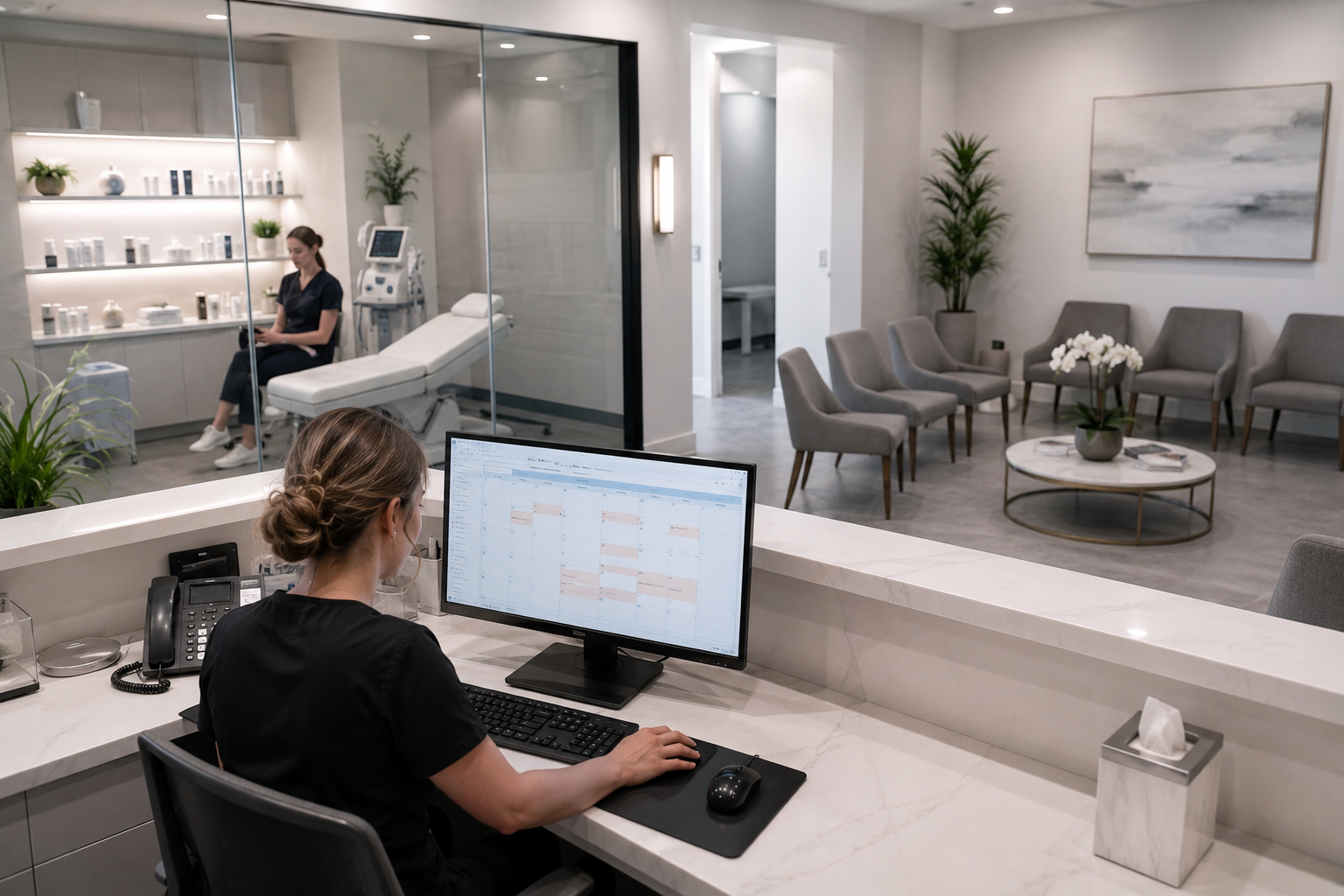 Optimistic owners often staff for the practice they hope to have rather than the one they actually run. Hiring a full roster before the bookings exist puts payroll on the clock while revenue is still catching up.
Provider compensation typically runs a quarter to a third of revenue, so every premature hire is a heavy bet. When demand lags the payroll, the owner absorbs the gap out of their own draw.
The disciplined approach is to staff to booked, proven demand and add capacity as utilization climbs. Part-time and flexible arrangements bridge growth without locking in fixed costs too early.
Hire to your calendar, not to your hopes. Capacity should follow demand, never race ahead of it.
In many med spas, everyone does a little of everything, which feels efficient and quietly isn’t. When no one owns a task, important things fall through the cracks, and finger-pointing fills the gap.
Unclear roles slow every process, from intake to follow-up to closing out the day. They also make training painful, because there’s no defined standard to train against.
Defining who owns what and what good looks like for each role removes the daily friction. It turns a group of busy people into a team with a system.
Accountability isn’t about pressure; it’s about clarity. People perform when they know exactly what they’re responsible for.
A med spa calendar left to chance fills unevenly, with idle gaps in some hours and chaos in others. Every empty provider hour is revenue you can never recover, because time is the one thing you can’t restock.
Smart scheduling sets utilization targets, protects high-value appointment types, and fills gaps deliberately. Missed calls and slow follow-up are where most of those gaps come from in the first place.
Capturing that demand is largely an automation problem now. Our AI-powered booking system captures every call and fills the calendar, answers around the clock, and books clients the moment they reach out.
When the calendar runs on rules instead of luck, utilization climbs on its own. Predictable scheduling is predictable revenue.
The most dangerous operational mistakes aren’t the ones that cost a little revenue; they’re the ones that risk the whole license. Compliance and documentation gaps stay invisible right up until an audit, a complaint, or an adverse event makes them very visible.
Medical aesthetic services carry real regulatory weight, and most states require active physician or medical-director oversight for the treatments a med spa provides. Letting that oversight lapse, or failing to keep credential records current, turns a routine paperwork task into an existential risk.
Documentation is the other half of the exposure. Missing consent forms, thin treatment notes, and scattered client records create both care risk and liability, and they’re entirely preventable with a system.
None of these fixes is complicated, but they do require a system rather than good intentions. The practices that sleep well at night are the ones that made documentation and oversight routine instead of optional.
Operational mistakes are rarely dramatic, but added together, they decide whether your practice grows or just stays busy. The good news is that every one of them is fixable once the right systems are in place.
At MedSpa Optimization, we help owners turn scattered operations into a practice that runs smoothly without constant supervision. Call us today to book a free strategy session and start closing the gaps that are quietly costing you.
The most common is running the business on memory instead of on systems. Inventory, scheduling, and documentation all get handled ad hoc, which works at low volume but breaks down as the practice grows and the small leaks start to compound.
It hurts in two directions at once. Overstocking ties up cash in product that expires unused, while stockouts turn away clients who came in for a specific treatment. The American Med Spa Association has flagged inventory mismanagement as one of the most overlooked drains on med spa profit, for exactly this reason.
Staff to your booked, proven demand rather than the growth you hope for. Provider compensation is usually the highest cost in the practice, so adding capacity ahead of bookings puts payroll on the clock before the revenue exists to cover it.
At a minimum, current provider credentials and licenses, an active medical-director or physician-oversight arrangement where your state requires it, signed consent forms, and complete treatment notes for every client. Keeping them centralized and current is what protects the practice if anyone ever asks.
Yes, and small practices benefit most. Documented procedures keep service consistent, make training a new hire far faster, and ensure the business doesn’t live entirely in the owner’s head.
Look at provider utilization, which is the share of available appointment hours that are actually booked and producing. If you see idle gaps, frequent missed calls, or slow follow-up, the calendar is leaking revenue you could recover with better systems.
Utilization is how much of each provider’s available time is booked with paying clients. It matters because staff is your highest fixed cost, so every idle hour is money spent without return, and small utilization gains often beat new-client volume for profit.
Fix them one system at a time, starting with the area leaking the most. Tackling inventory, scheduling, or documentation in sequence lets you improve operations while the practice keeps running, rather than halting everything for a full overhaul.

Loyalty programs provide medspas with an effective method to retain clients, boost revenue, and foster long-term relationships. These programs reward clients for coming back, encouraging steady visits w...

The most cost-effective way to market a med spa on a tight budget is by focusing on local SEO (Google Business Profile optimization), building a strong referral program, and utilizing targeted email/SMS...

Running a medspa is more than just offering beauty treatments—it’s a business that requires smart financial planning. Everything from pricing strategies to daily operations impacts long-term profitabili...

Running a medspa means more than offering high-quality treatments; it also requires operational precision. Even the best clinical services can be overshadowed by inefficiencies behind the scenes. If you...

Why Schedule a Call With Us?


